Obesity insulin resistance and cravings
Table of contents
Such a weird combination
Such a weird combination someone would think, what does obesity, insulin resistance and cravings have in common? Are they related to each other?
This will be the topic for this article.
What is what
Before we discuss the connection between these terms, we need to define them.
Obesity
Everyone knows what obesity is. According to World Health Organization obesity is:
Overweight and obesity are defined as abnormal or excessive fat accumulation that presents a risk to health. A body mass index (BMI) over 25 is considered overweight, and over 30 is obese. In 2019, an estimated 5 million noncommunicable disease (NCD) deaths were caused by higher-than-optimal BMI.
Using the BMI as your sole indicator for obesity is a bit myopic. I know people who were very athletic and had a BMI higher than 30, so technically they were obese. So we need to take BMI based definitions with a grain of salt, but let’s focus on the non athletes who have a BMI over 30.
I used to be one of these people in the past, and I am not very far now, my current BMI is 26.
Insulin resistance
Insulin resistance is not as famous as obesity, it is a bit obscure, those who know what it is must have someone close to them that may be diabetic or pre-diabetic.
According to the British diabetes centre insulin resistance is:
Insulin resistance is when your body’s cells don’t respond properly to the hormone insulin. So instead of keeping your blood sugar levels stable and within a healthy range, your blood sugar levels can rise.
Also
If you don’t have diabetes, insulin resistance can increase your risk of diabetes and lead to diabetes if your pancreas isn’t able to produce enough insulin to overcome the resistance and keep your blood sugar levels within a healthy blood sugar range. So you may then be at risk of prediabetes, type 2 diabetes or gestational diabetes (during pregnancy).
Quite sneaky, isn’t it? If you have it, you may eventually become pre-diabetic and finally diabetic. Also, it is a condition that most doctors do not inform people about.
In addition to that, doctors do not know exactly what is causing insulin resistance. But they have noticed some common patterns:
You are more likely to have insulin resistance if you have too much fat stored in and around your liver and pancreas, and high blood fats such as high triglycerides, or cholesterol. Insulin resistance is linked to living with overweight or obesity, but it can affect some people of a healthy weight or BMI.
and
Insulin resistance is often linked to living with obesity. But some other conditions such as polycystic ovary syndrome (PCOS) can cause insulin resistance and sometimes severe insulin resistance. Rare conditions causing severe insulin resistance include insulin receptor mutations, insulin receptor antibodies and lipodystrophy (abnormal fat distribution).
This last one is extremely common. I know a lot of women that gain weight and have a really hard time losing it, likelier than not they are insulin resistant because of PCOS.
This was an undiagnosed condition for a very long time, and even now that it is recognised it is still very tedious to diagnose.
But the funny thing is that someone can be insulin resistant even without being obese.
Very sneaky
Cravings
Craving sugar can be attributed to several factors. It can have a psychological cause, it can be stress related, or there may be other medical factors such as diabetes or being insulin resistant.
When eating something sweet, depending on the type of sugar it contains it may, when broken down in our body, to cause a sugar spike in our blood. Then our body will produce insulin to manage the sugar spike, but with people with either insulin resistance or diabetes, this mechanism does not work well.
Either, their bodies do not produce enough insulin, or the insulin produced can not be used by their organism in order to absorb the high sugar levels.
Often when this mechanism is not working right the organism might end up producing too much insulin and this leads it from a sugar spike, to a sugar crash, which triggers the feeling of craving and leads to another sugar spike and a sugar crash and so on. We can read more about this in NHS websites, or various companies that are specialising on nutrition.
The following diagram from mylevels.com shows this diagrammatically
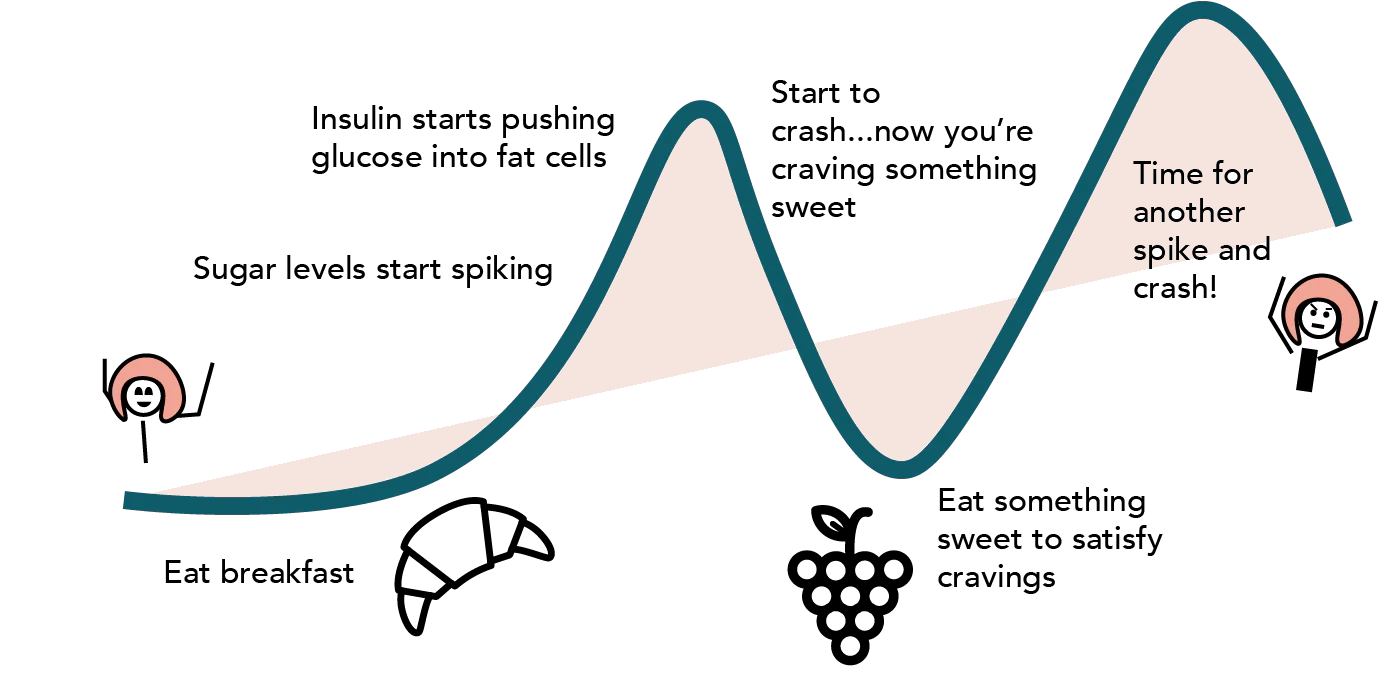
This situation leads to over eating, has the potential of causing obesity and diabetes. These blood sugar spikes, can and should be avoided
Keeping things even
The solution to all the issues above is to keep your blood sugar as even as possible.
This can be accomplished by using improved diet and increasing your levels of exercise.
Each person is unique, and each person has a different response to various types of foods, so although there is a list of known foods that cause blood sugar spikes (have high glycaemic index) and foods that have low glycaemic index, this list is not exhaustive.
Continuous monitoring of blood sugar is possible these days, and technology is improving on a daily basis to make this easily accessible and non-invasive. Apple is working on introducing a blood sugar sensor in its Apple Watch, and I am pretty sure other companies are working on it too.
The current wisdom is that if we regulate our carb intake, we can normalise the levels of sugar in our blood.
We can do this by focusing on a protein based diet combined with carbs with low glycaemic index, that allows our blood sugar level to remain stable in combination with targeted exercise that helps our body to have a well regulated metabolism and avoid or reduce insulin resistance.
Exercise can both help use any excess levels of sugar in the blood, and control obesity, which can keep insulin resistance at bay.