About amateur radio digital mode FT8
Table of contents
What is the fuss about digital modes
The gear
I have referred briefly to digital modes in amateur radio in a previous article. This is an article dedicated to them.
In the last few years, the amateur radio landscape has been transformed. In the past, radio transmitters were largely analogue, eventually became transmitter based and recently have evolved to software defined radios, or otherwise known as SDR.
This means that modern radios are not simple electronic devices that have the capabilities of modulating and demodulating signals and voice, it means that most modern radios are basically computers with a radio module attached to them, that does filtering, and power amplification.
Modulation and demodulation happens in the computer layer, and there are open-source projects such as GNU Radio that allow any computer with an RF module to encode and decode signals.
Modern radio companies such as the Chinese Xiegu as well the American Elect raft as well as established radio companies such as Kenwood and Yaesu, design radios based on Linux with their custom designs for the radio module.
The modes
CW
When we are talking about radio modes, we are referring to types of transmission. Text, voice, image and data communications are possible. Each one of these modes have their own technical characteristics and are widely different from each other. As we are starting discussing Digital modes in opposition to Analogue modes, we need to remember that the original radio mode was morse code, also known in the amateur radio community as CW.
CW is potentially the simplest and at the same time most resilient mode. A CW transmitter and receiver can be created with a handful of low-cost materials. The simplest CW receiver is called crystal radio and can be constructed by a handful of components.
CW mode is using the carrier signal itself, by interrupting and re-establishing transmission on a specific frequency we form beeping sounds that can be interpreted as dashes and periods depending on the duration of the signal.
This original radio mode is by definition digital. It has 2 digits, and this is why a lot of these modern radios come with CW encoders and decoders build in. They can decode any CW messages they receive and present them in their screen and vice versa encode test typed in a keyboard for transmission.
Voice
After CW the next evolution of radio modes were voice based, initial we had Amplitude Modulation also known as AM is one of the earliest radio modules after CW. Other voice modes are Single Side Band also known as SSB and Frequency Modulation also known as FM.
We are not going to present the technical details of these modes in this article, these will most likely be presented in their own sections.
Data
Amateur radioteletype also known as RTTY is one of the first amateur radio data modes. It follows the same concept teletypes over the wires were using, and it was used to transmit text over the radio. In these modes, the analogue radio signal is used to modulate audio, which in its turn is used in the same ways a modem can be used to transmit and receive data.
That is why data modes look and sound very much like old school modems when listened to on a speaker.
Slow scan TV also known as SSTV is another data mode that can be used to transmit images. It sounds very much like an old school modem transmission and needs a computer to be connected to the radio in order to decode the signal.
This applies to RTTY as well, in order to encode and decode signals we need a computer.
The gear and the modes combined
We can now see how the new capabilities of the new age radios can be combined with digital modes to do even cooler things, far beyond what the digital mode pioneers imagined.
I have mentioned in one of my previous articles that amateur radio is used by various scientific teams. The result of one of these efforts is the Weak Signal Propagation protocol, otherwise known as WSPR originally designed to test radio propagation paths across the globe, by Joe Taylor, K1JT who is an American astrophysicist and Nobel laureate.
Initially, this protocol and the software that implemented it, was proprietary but has since been released as open source.
WSJTX
WSPR is implemented by a tool called WSJTX or, otherwise known Weak Signal Communication, by K1JT.
WSJTX is one of the main tools used in modern digital modes, and it supports all sort of cool functionality such as specific digital protocols optimized for EME (moon bounce), meteor scatter, and ionospheric scatter, at VHF/UHF, as well as for LF, MF, and HF propagation.
The program can decode fraction-of-a-second signals reflected from ionized meteor trails and steady signals more than 10 dB below the audible threshold.
WSJT-X incorporates nearly all popular capabilities of the former programs WSJT and WSPR, while adding comprehensive rig control and many other modes FT4, FT8, FST4, FST4S, JT4, JT9, JT65, Q65, MSK144, and WSPR.
We can see a screenshot of WSJTX in action in the screenshot below:
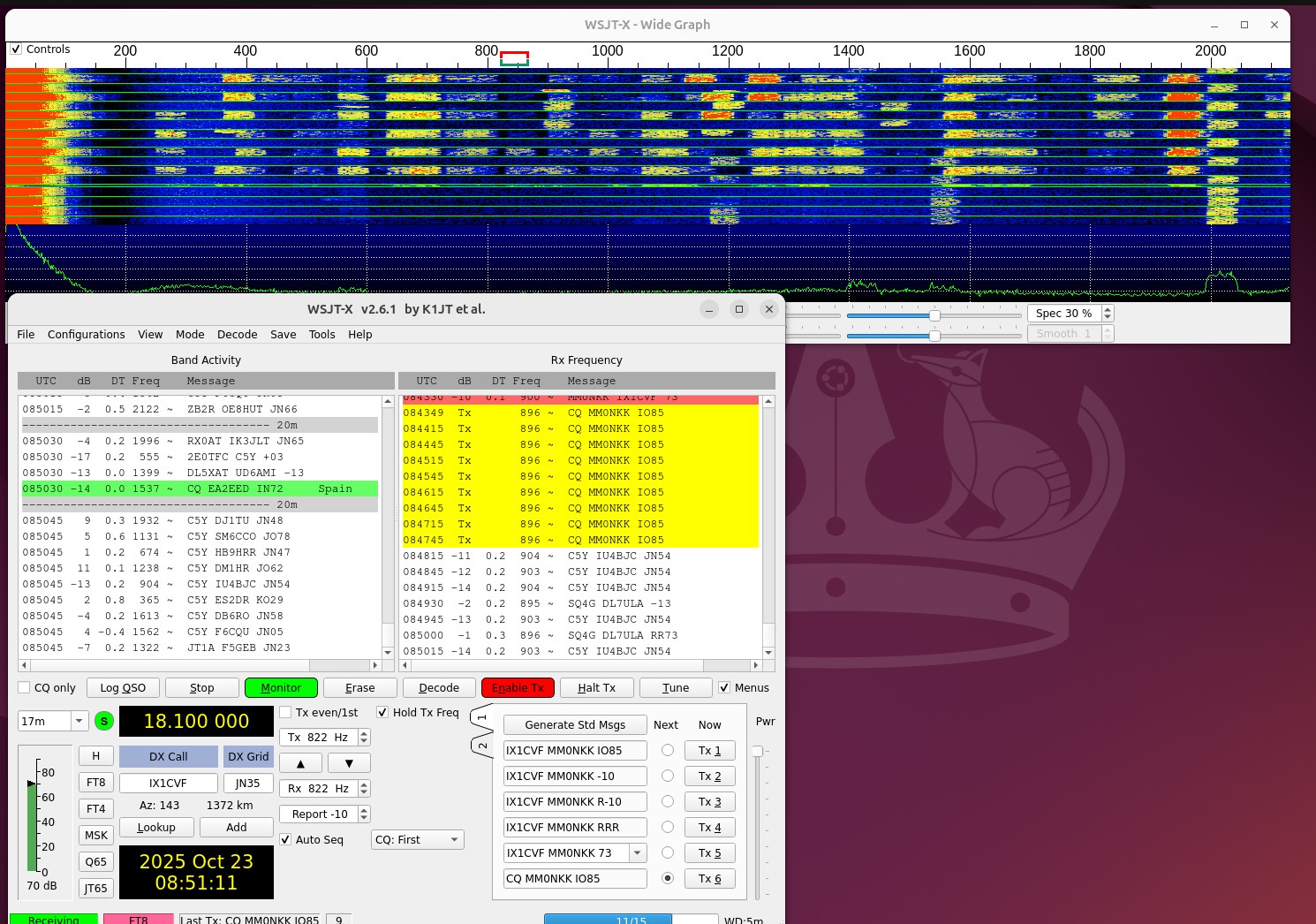 We can see the waterfall where signals are decoded at the 17m band, and we can see that I have just finished making a contact, and I am requesting for any new contacts.
WSJTX is very lightweight, and it can run happily on a Raspberry Pi 3b+ as we can see in the screenshot. This particular session is forwarded over an SSH tunnel to my personal laptop from the area where my radio is.
WSPR in WSJTX
WSJTX supports all sort of modes, it supports FT8 as we saw in the screenshot, but it supports a lot of other modes as mentioned before, and it also supports reporting everything back to a service called pskreporter.
PSK Reporter is an amateur radio signal reporting and spotting network and website started by Philip Gladstone in 2014 which allows operators to see where their radio signals are being received.
The platform works by collecting digital signal reports from software clients such as WSJT and FLDIGI, then mapping them to show which stations are being heard by other clients.
These signal reports are commonly used to see if your station is head and if it is, how far it can go. It can also show us if an antenna has a specific radiation pattern, and as such it is invaluable for amateur radio experiments. Another common use case it to show us if the bands are open.
Bands are not always available to us, depending on solar activity and other environmental factors, and having a way to visualise if signals can go through is quite valuable.
WSJTX is reporting these signal reports even without an operator, so even by leaving it open, it can help people debug their setup. We can see pskreporter in action in the following screenshot:
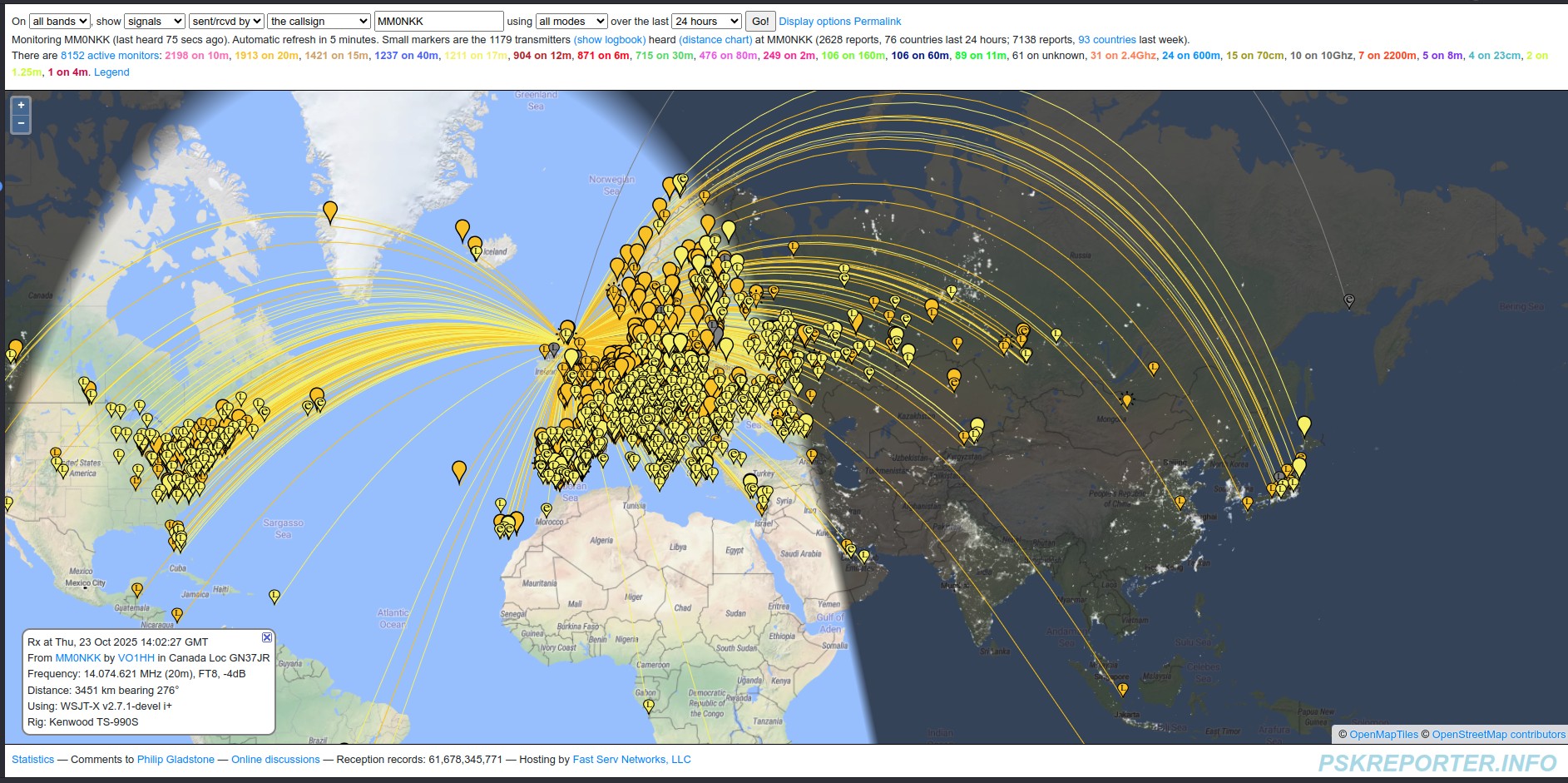
This screenshot can show the activity of my station, both for receiving and transmitting signals across the world. We can also see the details of each station decoded as well as the quality of the signal according to WSJTX signal strength definition.
We can finetune and filter this map and in the following diagram we can see the map only for the received signals from my station
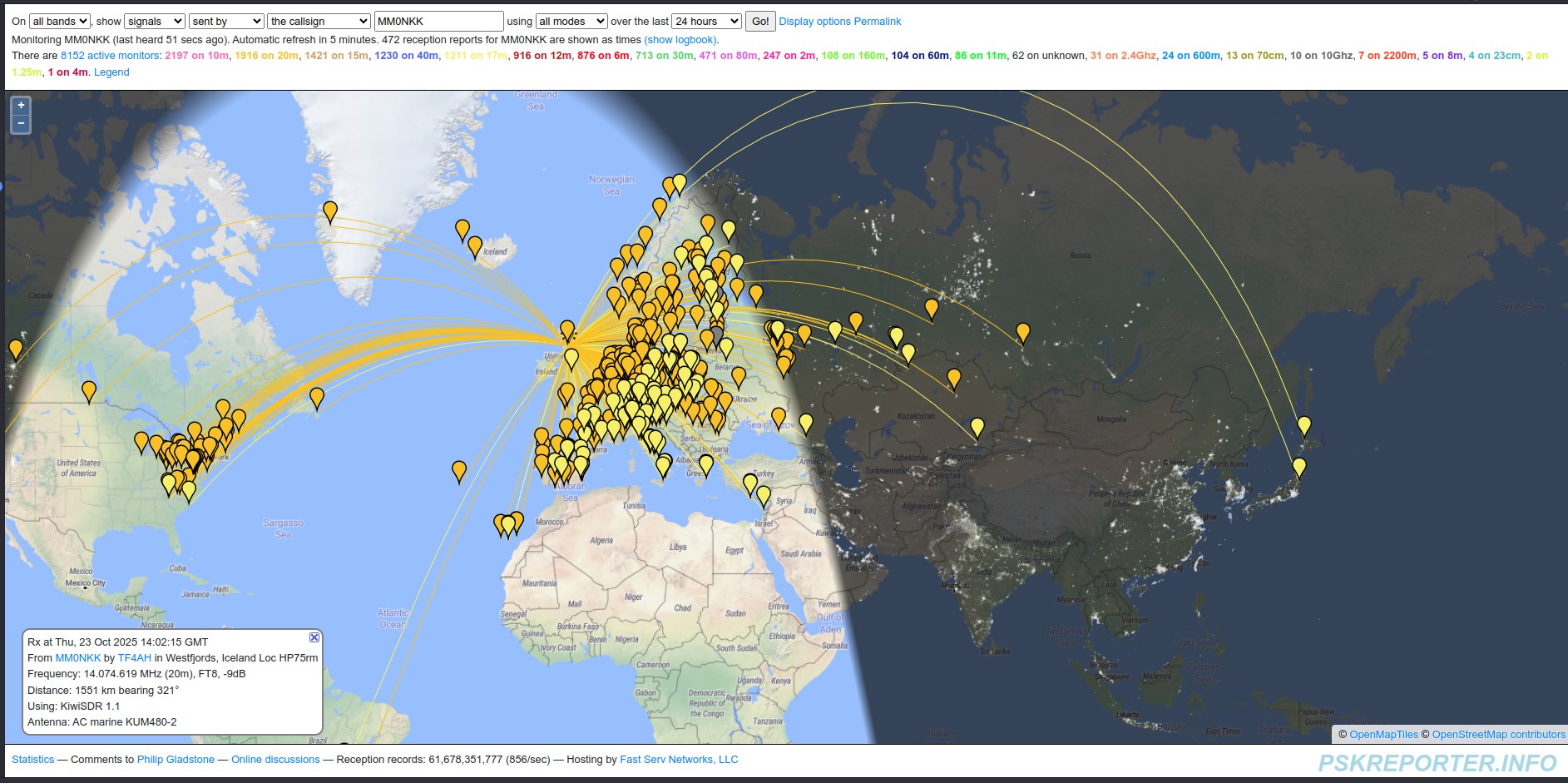
we can see that the transmitted signals are not nearly as many as the received ones.